
Maternal iron deficiency anemia (IDA) significantly impairs fetal iron stores, increasing the risk of iron deficiency and iron deficiency anemia in infants. This relationship persists from birth through the first year, though timely maternal supplementation can mitigate some adverse developmental and hematological outcomes in infants but not all.
Iron is essential for growth and development in infants and toddlers. Symptoms including behaviour, tantrums, sleep problems, learning, cognition, late crawling, and poor growth and development are just some of the risk factors in infants and children with iron deficiency and iron deficiency anemia.
Maternal Anemia and Infant Iron Status
There is a strong, positive association between maternal iron status during pregnancy and the hematological profile of the newborn.1,2,3,4 Research consistently demonstrates that infants born to mothers with iron-deficiency anemia (IDA) exhibit significantly lower levels of hemoglobin and serum ferritin in their cord blood compared to infants born to non-anemic mothers.2,3,4,5 This indicates that iron supply to the fetus is reduced during maternal anemia, as the fetus extracts iron in amounts directly proportional to the levels available in the maternal circulation.5
The impact of this maternal deficiency extends beyond birth, as these infants remain at an increased risk of developing anemia and iron deficiency throughout infancy.1,6,3 Maternal anemia is recognized as a leading cause of childhood anemia, with studies confirming that even infants born to mildly anemic mothers are at risk.1,7
Timing and Severity of Impacts

The effects of maternal iron deficiency on the infant are observable at birth and continue to manifest during the first year of life.6,2,3
- At birth: Babies who are 4 weeks old or younger born from anemic mothers show significantly reduced iron reserves, with the severity of maternal anemia directly influencing the degree of fetal iron depletion.4,5
- Early infancy (6 months): Maternal IDA is linked to an increased risk of infant anemia at six months of age.6
- Late infancy (9–14 months): The correlation between maternal and infant hemoglobin and ferritin levels persists at 9 and 14 weeks post-birth.1,2,3 Furthermore, low levels of hepcidin in mothers during gestation—a marker for iron deficiency—are associated with lower infant hemoglobin and higher soluble transferrin receptor to ferritin ratios at 12 months.6
The severity of maternal iron deficiency is a critical factor. One study of 150 prenatal mothers found that 60% of those with iron deficiency had low ferritin levels, categorized as mild (45.56%), moderate (47.78%), or severe (6.66%).8 Infants born to mothers with moderate to severe anemia specifically demonstrate significantly lower cord serum ferritin and poorer initial iron stores.5
Long-term Health and Interventions
Maternal iron deficiency during pregnancy is associated with several adverse perinatal outcomes, which indirectly influence the child's health trajectory.9 Gestational anemia is linked to an increased risk of threatened miscarriage, chronic placental insufficiency, and higher rates of caesarian sections.9 These complications, combined with increased infectious morbidity in mothers and insufficient lactation, contribute to the poor health status of children.9
However, medical interventions can modify these risks. The following table summarizes findings regarding the efficacy of maternal iron therapy:
| Intervention | Impact on Infant Health |
| Iron supplementation | Reduces negative impacts (growth delays, weight, height, development indicators) and iron stores. |
| Treated anemia | Not associated with low birth weight at 6 or 12 months. |
| Infection risk | Maternal therapy lowers the frequency of infant IDA at 6 months. |
Treated anemia significantly reduces the risk of anemia at 6 months.9 Consequently, prompt identification and management of maternal iron status are essential to prevent the longitudinal depletion of infant iron stores and associated health risks.2, 3, 4
Supplementing with Gentle BioFe® Iron Before & During Pregnancy
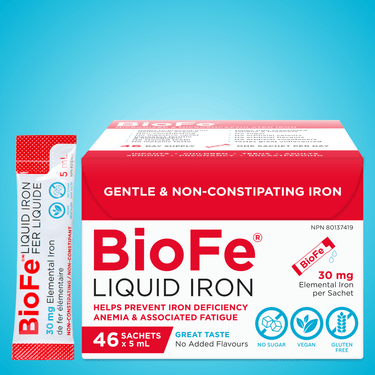
Iron stores need to be at optimal levels prior to pregnancy. BioFe® liquid iron supplements are perfect for women thinking about getting pregnant but can also be used during a pregnancy. BioFe+® liquid iron with added vitamins B6 and B12 contains 15 mg of elemental iron per teaspoon; two teaspoons is the recommended daily pregnancy maintenance dose. For those requiring a higher dose, BioFe® liquid is available in convenient sachets containing 30 mg.
All BioFe® iron liquid formulas have no added flavour and no sugar, but they taste great.
| BioFe+® Liquid Iron with Vitamin B6 & B12 | ||
 |
 |
 |
|
|
|
BioFe® Iron Drops for Infants at Birth and Beyond
As most mothers do not have adequate iron stores during pregnancy and at delivery, infants require iron supplementation from birth. BioFe® iron drops are unflavoured in MCT oil and no other ingredients. It can be given directly or easily mixed into breastmilk or formula.
|
BioFe Iron Drops for Infants & Children
|
 |
BioFe® Iron Overcomes Taste & Sensory Aversion to Ensure Treatment Compliance

Even the most effective iron supplement cannot deliver results if patients do not take it consistently. We have heard from our practitioners that they know patients are not taking the prescribed iron supplements because their iron levels are not increasing.
Overcoming taste and sensory aversion, and common side effects, including constipation, stomach upset and stained teeth, are the greatest challenges for treatment compliance. If patients are not taking their iron supplements, their iron levels will never improve.
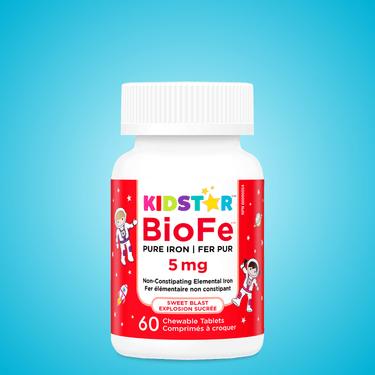
BioFe® provides a great-tasting iron with no metallic taste that is available in multiple formats, from infant drops, tiny chewable tablets and liquids in various doses, providing flexible supplementation options for patients.
Download Our Free Product Comparison Chart

References
[1] N. Savoie, “Impact of maternal anemia on the infant’s iron status at 9 months of age.,” Canadian Journal of Public Health-revue Canadienne De Sante Publique, vol. 93, no. 3, pp. 203–207, May 2002, doi: 10.1007/BF03405001.
[2] A. Bajpai, R. Devi, A. Rai, R. Kumari, and D. GP, “Maternal Iron Deficiency Anemia Affects Fetal Growth, Maturity and Level of Iron in India: A Cohort Study,” Sept. 2025, doi: 10.5281/zenodo.17091733.
[3] A. K. Shukla, S. Srivastava, and G. Verma, “Effect of maternal anemia on the status of iron stores in infants: A cohort study.,” Journal of Family and Community Medicine, vol. 26, no. 2, pp. 118–122, May 2019, doi: 10.4103/JFCM.JFCM_115_18.
[4] V. Agrawal, V. Jain, and P. Sahu, “Cord Blood Iron Status In Maternal Iron Deficiency Anaemia,” National journal of integrated research in medicine, vol. 7, no. 3, pp. 21–24, Jan. 2016.
[5] P. N. Singla, M. Tyagi, R. Shankar, D. Dash, and A. Kumar, “Fetal iron status in maternal anemia,” Obstetrical & Gynecological Survey, vol. 52, no. 7, p. 410, July 1997, doi: 10.1097/00006254-199707000-00009.
[6] A. I. Abioye et al., “Maternal anemia type during pregnancy is associated with anemia risk among offspring during infancy,” Pediatric Research, vol. 86, no. 3, pp. 396–402, May 2019, doi: 10.1038/S41390-019-0433-5.
[7] N. M. Abu-Ouf and M. M. Jan, “The impact of maternal iron deficiency and iron deficiency anemia on child’s health,” Saudi Medical Journal, vol. 36, no. 2, pp. 146–149, Feb. 2015, doi: 10.15537/SMJ.2015.2.10289.
[8] S. Zahoor, A. Latif, H. Khan, M. Khalid, S. Z. K. Bukhari, and S. Ambreen, “Association of Low Ferritin Level of new Born with Iron Deficiency Anemia in Mothers,” Pakistan Journal of Medical and Health Sciences, vol. 17, no. 1, pp. 713–715, Jan. 2023, doi: 10.53350/pjmhs2023171713.
[9] Е. А. Балашова, Л. И. Мазур, Ю. В. Тезиков, and И. С. Липатов, “Влияние коррекции железодефицитных состояний у беременных на течение перинатального периода и формирование здоровья детей,” vol. 65, no. 1, pp. 51–58, Mar. 2020, doi: 10.21508/1027-4065-2020-65-1-51-58.